Experience the Celebes Sea
Diving the Derawan Archipelago
Thresher sharks, barracuda tornadoes, pristine reefs, and a jellyfish lake unlike anywhere else. Four destinations, each with its own character, within a few hours of each other.
The Derawan Archipelago stretches across the Celebes Sea off the coast of East Kalimantan, encompassing far more than any single visit can cover. The resort dives four of its destinations: Maratua, Kakaban, Sangalaki, and the coastal waters of Talisayan.
On any given dive, the most reliable encounters are with reef life. Schooling chevron barracudas and trevallies are a near-constant presence at the right sites, and grey reef sharks patrol the reef edges with regularity. Larger pelagic highlights, including thresher sharks, whale sharks, and manta rays, are genuine possibilities but depend on season, conditions, and timing. Each destination below is described on its own terms.
Maratua
Maratua is a massive horseshoe-shaped atoll fringed entirely by coral reefs. Its outer edges are defined by severe limestone slopes plunging more than 200 metres into the abyssal plains of the Celebes Sea. This sheer topography is punctuated by deep-water channels that connect the sheltered inner lagoon directly to the open ocean. During tidal shifts, these channels generate extremely strong, multi-directional currents. It is this high-energy environment that reliably draws large pelagic predators.
The resort sits directly above its own house reef, Fantasy Wall — a wall dive accessible directly off the jetty with no boat required. The wall is defined by its coral density and structural variety: black corals, gorgonian sea fans, arborescent soft corals, and table corals colonise the face alongside brain corals, tube sponges, and tunicates. Ledges and overhangs break up the wall at intervals, providing shelter for anthias, damselfish, and a wide range of resident reef fish. Reef manta rays have been sighted here on rare occasions, though not reliably enough to plan around.
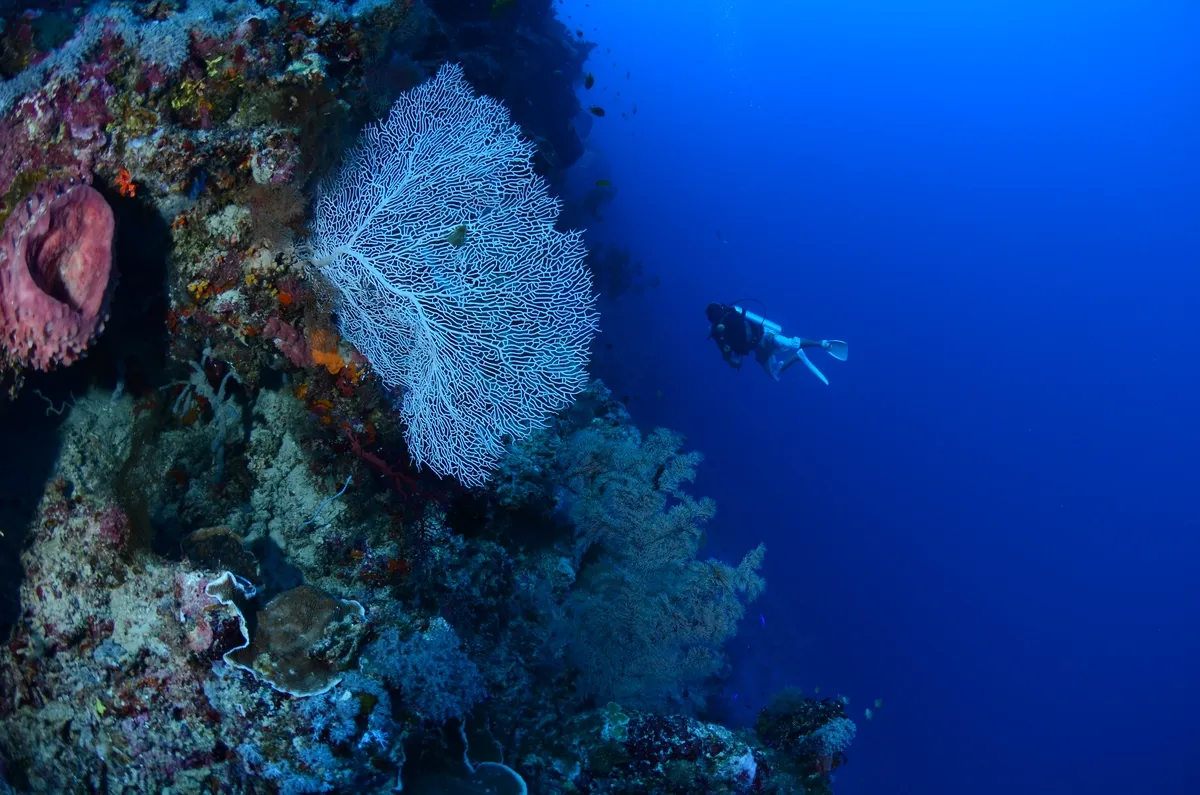
The direct jetty access makes Fantasy Wall a natural choice for early morning dives before the boats depart, evening dives on return, and night dives — when the wall’s character shifts considerably.
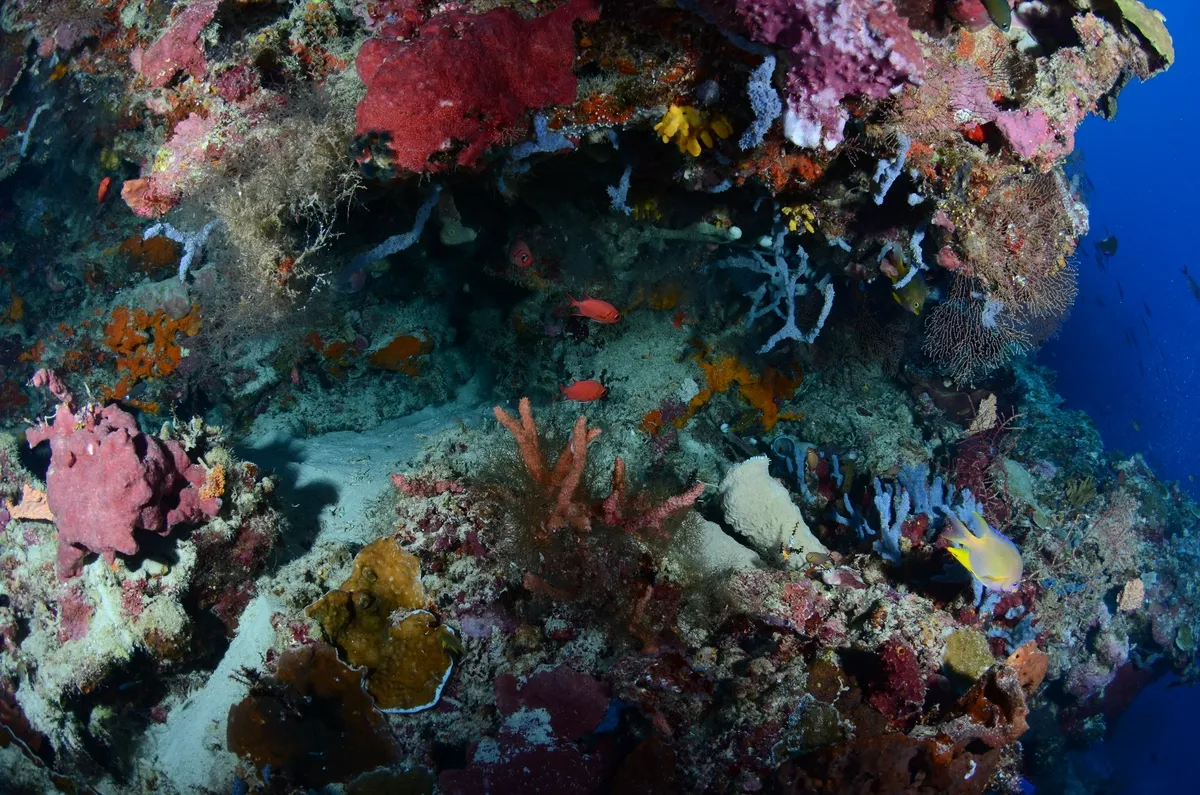
Mid Reef, on Maratua’s outer edge, is one of the archipelago’s better-known thresher shark sites.
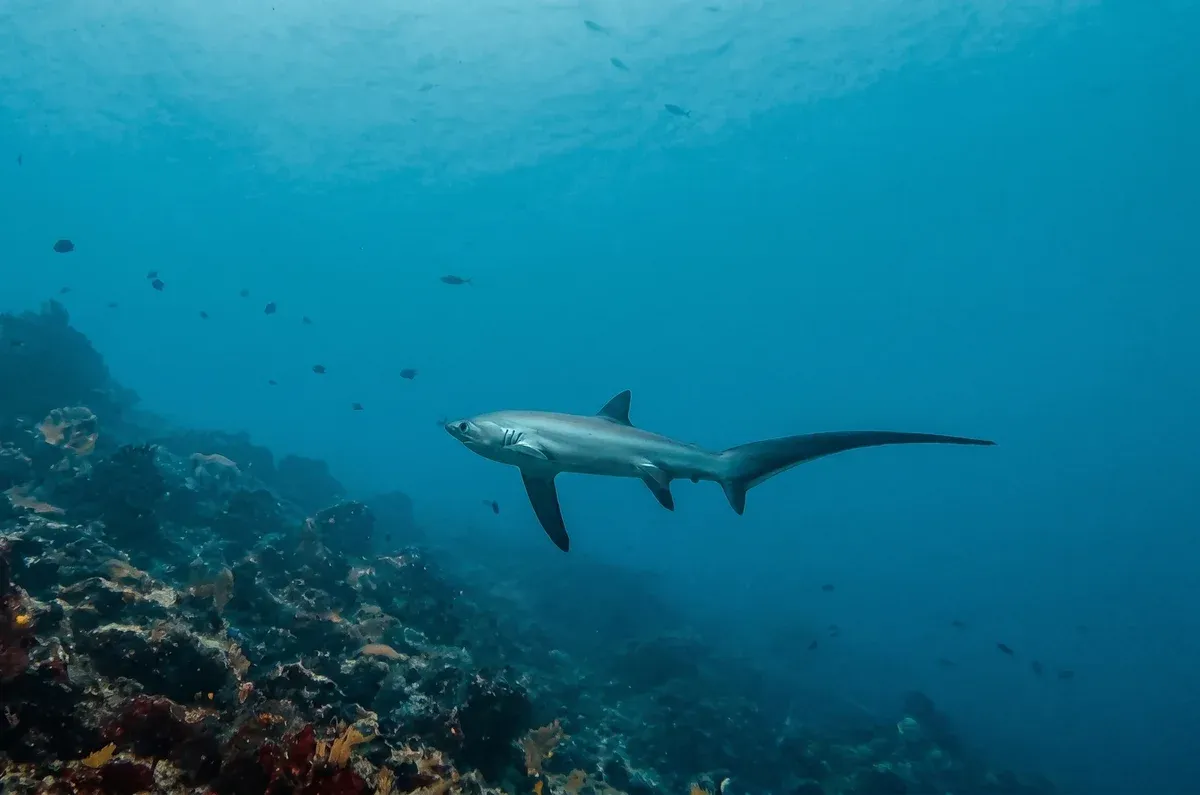
The sharks are present in these waters year-round, but whether they come within recreational depth depends on water temperature. When cold water pushes up to the shallower reef edge, the sharks move with it and encounters can be excellent. In warmer conditions they tend to remain deeper, below recreational limits. The team monitors conditions and can advise on timing before you dive.
At The Channel, also known as Big Fish Country, divers run a high-velocity drift through a narrow passage where the tidal flow concentrates marine life in extraordinary numbers. Grey reef sharks patrol the current lines. Eagle rays cruise overhead. Giant groupers hold station in the shelter of the rock. Schools of chevron barracudas form the famous barracuda tornado, a swirling vortex of thousands of fish that takes a full minute to pass through. Giant, bigeye, and bluefin trevallies move in tight formation alongside tunas, mackerel, and sweeping curtains of surgeonfish. A reef hook is mandatory; without one, the current will carry you through before you have had time to take it all in. When the flow finally delivers you into the calmer water beyond, the silence is startling.
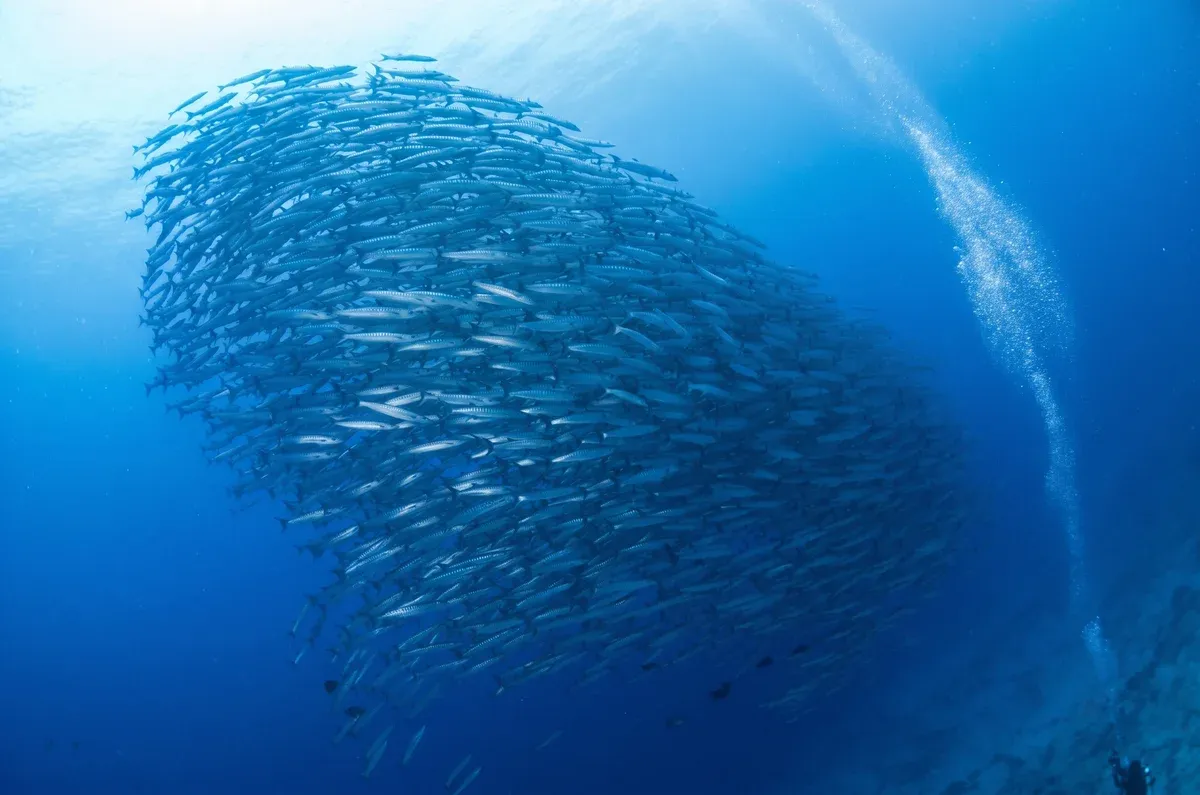
For a change of pace, the shallow reef flats at Turtle Traffic offer calm water and excellent visibility where green and hawksbill turtles gather at cleaning stations, largely indifferent to the divers watching them. Further along the atoll, the East Wall features deep drop-offs, mature black corals, and the submerged remnants of a World War II Japanese watchtower.
Kakaban
Kakaban is an uplifted limestone atoll with a stark environmental dichotomy. Because the island is entirely uninhabited, its reefs have never been subject to local fishing pressure or coastal development. The result is some of the most pristine coral in the archipelago: sheer oceanic walls plunging to 200 metres, swept by fierce, variable currents and oceanic upwellings.
Kelapa Dua, on Kakaban’s outer reef, is the second of the archipelago’s thresher shark sites, subject to the same cold-water conditions that govern sightings at Mid Reef. When the thermocline brings cold water up to the reef edge, encounters at both sites become a realistic prospect on the same trip.
At Barracuda Point, the outer wall delivers strong pelagic action. Hammerheads and leopard sharks have been recorded here and at Sangalaki, though neither is a reliable encounter. Treat them as a bonus.
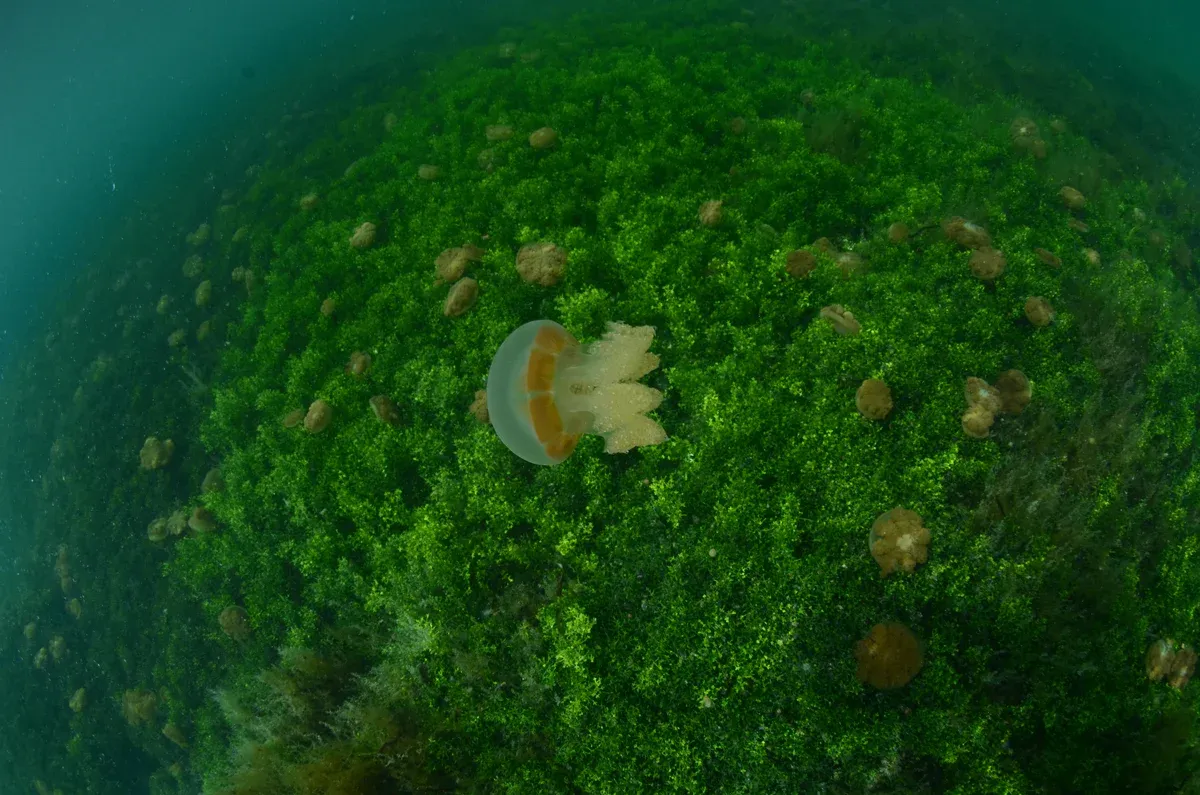
The true anomaly of Kakaban lies in its interior. Millennia ago, Holocene geological shifts trapped seawater inland to form a large marine lake, averaging 8 metres in depth with a muddy, mangrove-fringed bottom. Cut off from the sea and natural predators, this isolated sanctuary allowed four distinct jellyfish species, moon, spotted, box, and upside-down, to evolve and lose their stinging ability over thousands of generations. Visitors can snorkel amongst hundreds to thousands of these benign creatures at any one time. The experience is genuinely disorienting: no current, no reference points, just the quiet company of pulsing, translucent animals drifting through the water around you in every direction.
Strict preservation rules apply. Scuba diving is prohibited, both to protect the jellyfish from concussive exhaust bubbles and because the lake contains a lethal anoxic layer of hydrogen sulphide below 15 metres. Fins and sunscreen are also banned to maintain the fragile ecosystem.
Sangalaki
In direct geological contrast to the walls of Maratua and Kakaban, Sangalaki is a low-lying island surrounded by a sprawling, gently sloping lagoon. The reef descends gradually to roughly 24 metres across flat sandy bottoms, coral steps, and shallow gullies, creating a nutrient-rich, plankton-dense environment suited to filter-feeding megafauna.
Reef manta rays have historically been the primary draw here, and sightings remain possible year-round. Encounters have become less consistent in recent years, and guests should treat a manta sighting as a welcome bonus rather than a guarantee. When mantas are present, snorkelling can be as productive as diving given how close to the surface they feed.
The more consistent attraction on Sangalaki is its sea turtle conservation programme, managed jointly by the Turtle Foundation and BKSDA, Indonesia’s Natural Resources Conservation Agency. The island’s sandy ridges and seagrass beds make it one of the most significant green turtle nesting grounds in Southeast Asia. Dozens of turtles come ashore nightly to lay their eggs, and the conservation hatchery allows visitors to observe the hatchlings’ release. For many guests, an evening on Sangalaki beach proves as memorable as any dive.
Talisayan
Situated near the mainland coast of East Kalimantan, Talisayan offers an encounter found nowhere else in the archipelago. Traditional wooden floating fishing platforms, known as bagans, are anchored in the coastal waters, and it is around these structures that whale sharks gather, drawn by the small baitfish that slip through the nets or are discarded by the fishermen.
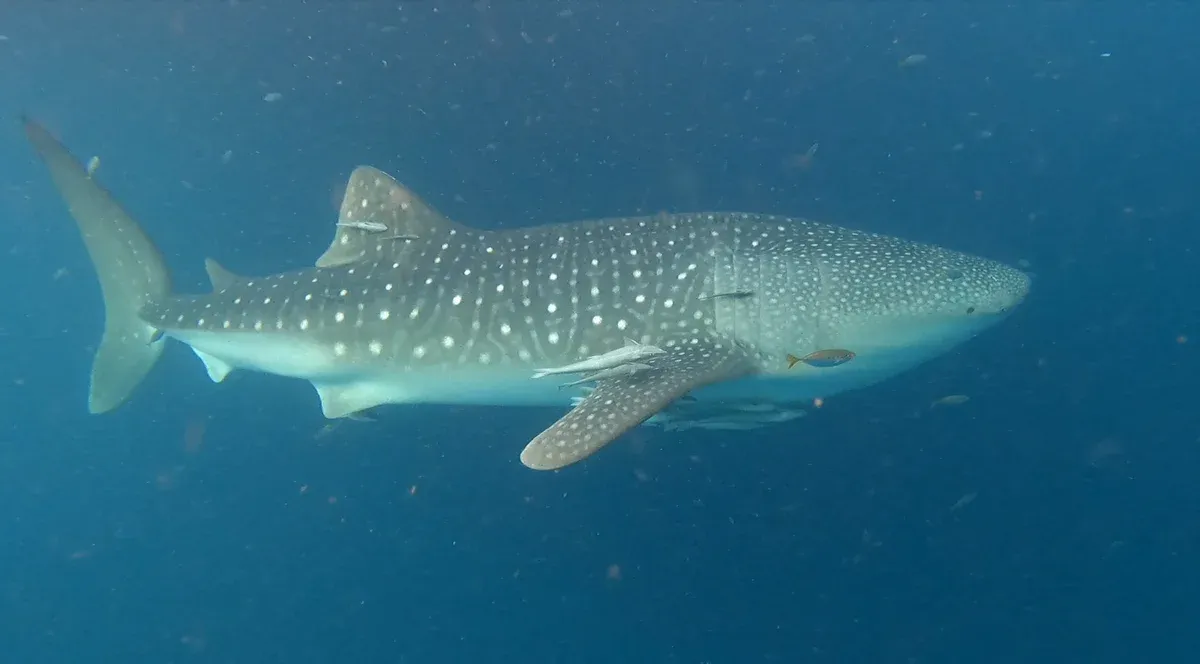
At dawn, in the low light of the early morning, watching a whale shark move slowly through the water column beneath you is an experience that stays with divers long after the dive log is full. Securing it requires commitment: boats must depart at approximately 4:30 AM to reach the bagans by sunrise, when the sharks are most active at the surface. It is early. It is worth it.
Diving with the Maratua Team
The sites above describe what is here. Who takes you into the water determines how much of it you actually see.
Our divemasters have spent years on these specific reefs. They understand how the tide behaves at each site, which monsoon conditions favour which locations, and when The Channel is running too hard to dive productively. That knowledge shapes every dive plan and every site briefing from the moment you arrive. On a destination this complex, local expertise is not an extra. It is the foundation of every dive.
A Note on Dive Insurance
Comprehensive dive insurance is strongly recommended before travelling to Maratua. The nearest recompression chamber is a significant journey from the island. DAN (Divers Alert Network) and similar providers offer dive-specific cover that includes emergency evacuation. Please ensure your policy is active before you arrive.